
Key Takeaways
- Verify the contractor holds active RICRLB registration for commercial work before hiring.
- Confirm every subcontractor on the project maintains separate RICRLB registration independently.
- Require a dedicated project manager as the single point of accountability for all coordination.
- Insist on a site foreman present through commissioning to maintain technical continuity.
What licenses does a Rhode Island mechanical contractor need?
What does RICRLB registration cover?
- Confirm the contractor holds active RICRLB registration for commercial work.
- Verify every subcontractor on the project also maintains separate RICRLB registration.
- Request registration numbers before work begins on any mechanical system.
Does a long-established contractor still need current registration?
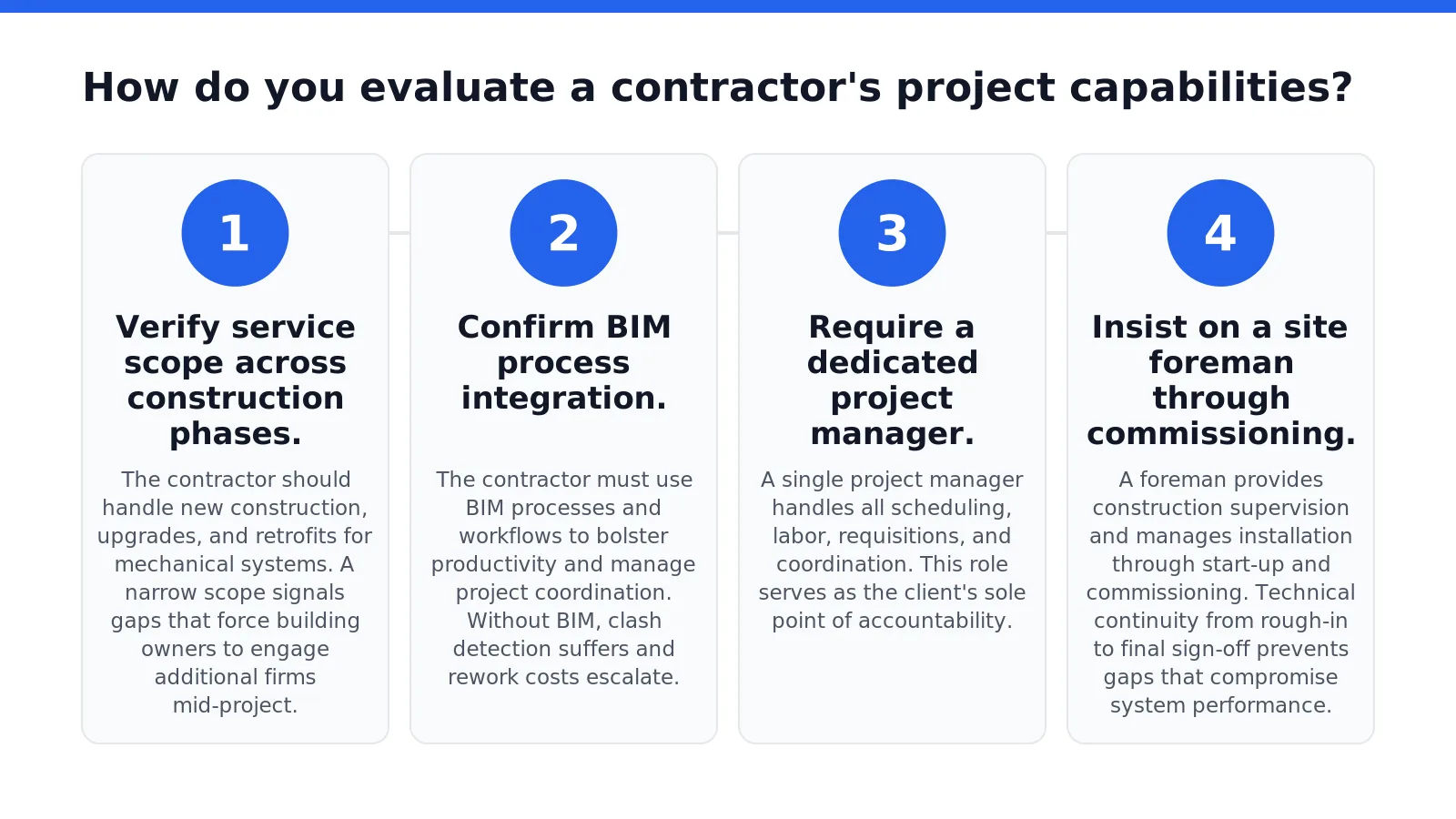
How do you evaluate a contractor's project capabilities?
- Verify service scope across construction phases. The contractor should handle new construction, upgrades, and retrofits for mechanical systems. A narrow scope signals gaps that force building owners to engage additional firms mid-project.
- Confirm BIM process integration. The contractor must use BIM processes and workflows to bolster productivity and manage project coordination. Without BIM, clash detection suffers and rework costs escalate.
- Require a dedicated project manager. A single project manager handles all scheduling, labor, requisitions, and coordination. This role serves as the client's sole point of accountability.
- Insist on a site foreman through commissioning. A foreman provides construction supervision and manages installation through start-up and commissioning. Technical continuity from rough-in to final sign-off prevents gaps that compromise system performance.
What project delivery methods should a mechanical contractor offer?
Why does BIM matter for project evaluation?